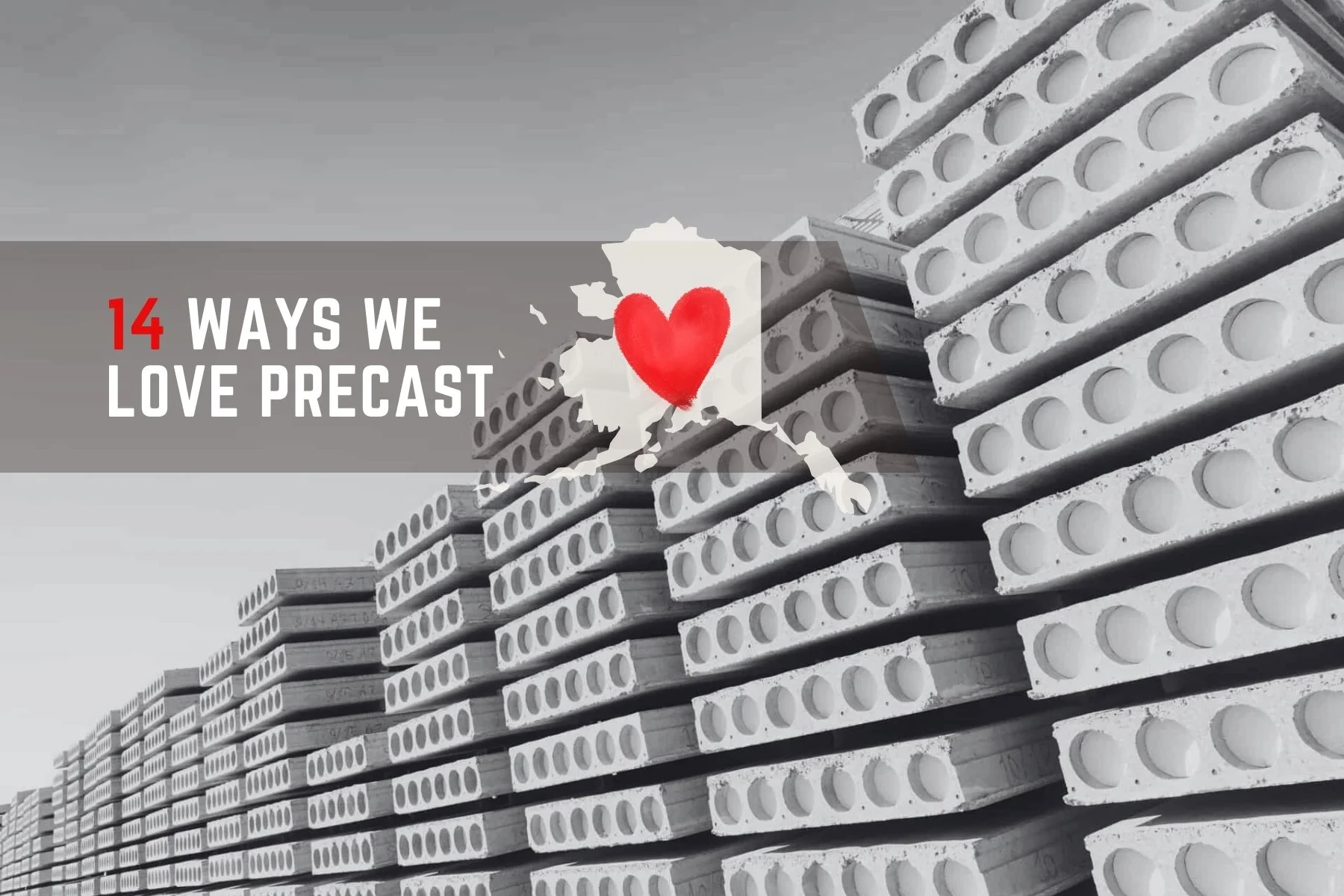
14 Ways We Love Precast
our favorite reasons alaska should fall in love with precast
While Valentine’s Day is usually reserved for flowers, dinner reservations, and handwritten notes, in our world it’s a good excuse to talk about something else we happen to love quite a bit: precast concrete. Not in a sentimental way — but in the way you value something that consistently delivers, solves real problems, and stands up to the realities of building in Alaska.
This February 14th, we’re sharing fourteen reasons we believe precast isn’t just lovable, it’s logical.
1. It Performs in Real Weather — Not Ideal Weather.
Precast isn’t poured in a race against snow, wind, or temperature swings. It’s manufactured in a controlled environment, then installed efficiently on site. That predictability matters in Alaska.
2. Speed Without Sacrificing Quality.
While foundations are being prepared, structural components are already produced so they’re ready to erect quickly on-site. That compresses schedules without compressing standards.
3. Strength Is Engineered In.
Prestressing creates structural efficiency that delivers long spans, high load capacity, and durable performance — without unnecessary material waste.
4. Consistency at Scale.
Factory production means repeatable quality. Every panel, plank, or structural element meets engineered specifications before it ever leaves the plant.
5. Built-In Fire Resistance.
Concrete doesn’t burn. It doesn’t fuel fire. That inherent protection adds resilience without added systems or coatings.
6. Designed for Long-Term Ownership.
Precast structures are low-maintenance, resistant to moisture intrusion, and less susceptible to rot, pests, or corrosion. That translates to lower lifecycle costs.
7. Quieter, More Comfortable Spaces.
The mass of concrete improves acoustic performance and contributes to more stable interior environments — something that matters in housing, schools, and commercial buildings alike.
8. Structural Freedom.
Long spans mean fewer columns. Fewer columns mean flexibility — whether it’s warehousing, modular housing, or future reconfiguration.
9. Safer, More Organized Job Sites.
With much of the labor happening in a manufacturing setting, on-site congestion is reduced and installation becomes more streamlined.
10. It Makes Remote Logistics More Predictable.
In a state where shipping windows, labor access, and weather can dictate outcomes, manufacturing components ahead of time improves planning and reduces risk.
11. Seismic-Ready Systems.
Properly engineered precast assemblies are designed to perform in seismic zones — a non-negotiable in much of Alaska.
12. Sustainable by Design.
Reduced site waste, optimized material use, and long service life all contribute to a more responsible building approach.
13. Supports Industrial Growth.
From warehouses and data centers to modular housing and critical infrastructure, precast scales to meet Alaska’s expanding industrial needs.
14. It’s Built for Alaska — Not Adapted to It.
Precast isn’t a workaround material. It’s a high-performance structural system that aligns with the realities of building in cold climates, remote regions, and demanding conditions.
As you can see, we don’t “love” precast because it’s trendy, we value it because it performs.
It solves real challenges — labor constraints, extreme climate, remote logistics, long-term durability — without compromise. And in a state where building isn’t easy, that matters.
So yes, this Valentine’s Day, we’ll say it: we’re committed to precast.
Built to last. Built for Alaska.
Interested in learning about precast for your next project? Contact our team.